Whole-home filtration
Compare a point-of-entry filter by the water you have, the result you want and the flow your household needs.
Understand this option → BySimple Water Service
Water treatment in Palm City, Florida
Explore water softening, whole-home filtration and well-water treatment for your Palm City home.
Conditions vary by home. Testing helps identify the right treatment.
Start with evidence
For a property supplied by Martin County Utilities, start with its 2025 Drinking Water Quality Report. The County’s utility service-area map helps identify the applicable provider. Confirm the current water account: a Palm City mailing address, an irrigation well or a nearby home’s report does not establish the household drinking-water source.
Before comparing equipment, confirm the water supplier on your bill or through the utility. Ask which source and report apply. Then describe the issue at home: scale, taste, visible particles, staining, a laboratory result or an aging filter. Each points toward a different decision. Plumbing, existing treatment and maintenance can change a home’s tap results after water leaves a utility.
A private well needs separate sampling. EPA's well-owner guidance explains routine tests and when conditions call for more. We will never describe an untested well as unsafe, or suggest that compliant utility water needs filtration to be safe.
Choose by the job
For well-specific issues, compare iron and staining and sulfur and odor.
Compare a point-of-entry filter by the water you have, the result you want and the flow your household needs.
Understand this option →Learn when measured hardness justifies an ion-exchange system and what a useful installation proposal must specify.
Understand this option →Compare under-sink drinking-water systems by certified reduction claims, output, installation and maintenance.
Understand this option →Test the individual well and design a serviceable treatment sequence around its findings and flow.
Understand this option →Start with the decision a test must answer and keep utility results separate from conditions at one property.
Understand this option →Equipment can be combined, but each component should have a defined purpose. A softener controls measured hardness; it does not replace a certified drinking-water filter. An under-sink reverse-osmosis unit treats a selected tap, not every shower. A whole-home filter needs a stated target and a flow rating that matches household demand. For a private well, the first useful purchase may be a laboratory test rather than a tank.
What the hardware does
A point-of-entry filter sits near the main line and is discussed for a defined whole-home goal, such as aesthetic taste or sediment. Media, contact time and flow influence whether a proposed design fits. Ion-exchange softening targets calcium and magnesium hardness that can contribute to scale and spotting. It needs salt or potassium, a drain and regular service.
Reverse osmosis at a drinking-water point uses a membrane with pretreatment and a concentrate stream. Cabinet space, pressure, storage and replacement filters affect fit. EPA describes a WaterSense specification for more efficient point-of-use RO. None of these categories, by name alone, establishes reduction of a specific substance. Check the exact product and claim.
For filtration claims, NSF explains the difference between aesthetic and specified health-related reduction standards. A standard number is not a blanket promise that every listed contaminant is removed by every product. An installer should show the listing for the exact proposed model and the substance that matters to your decision.
What you may see on site
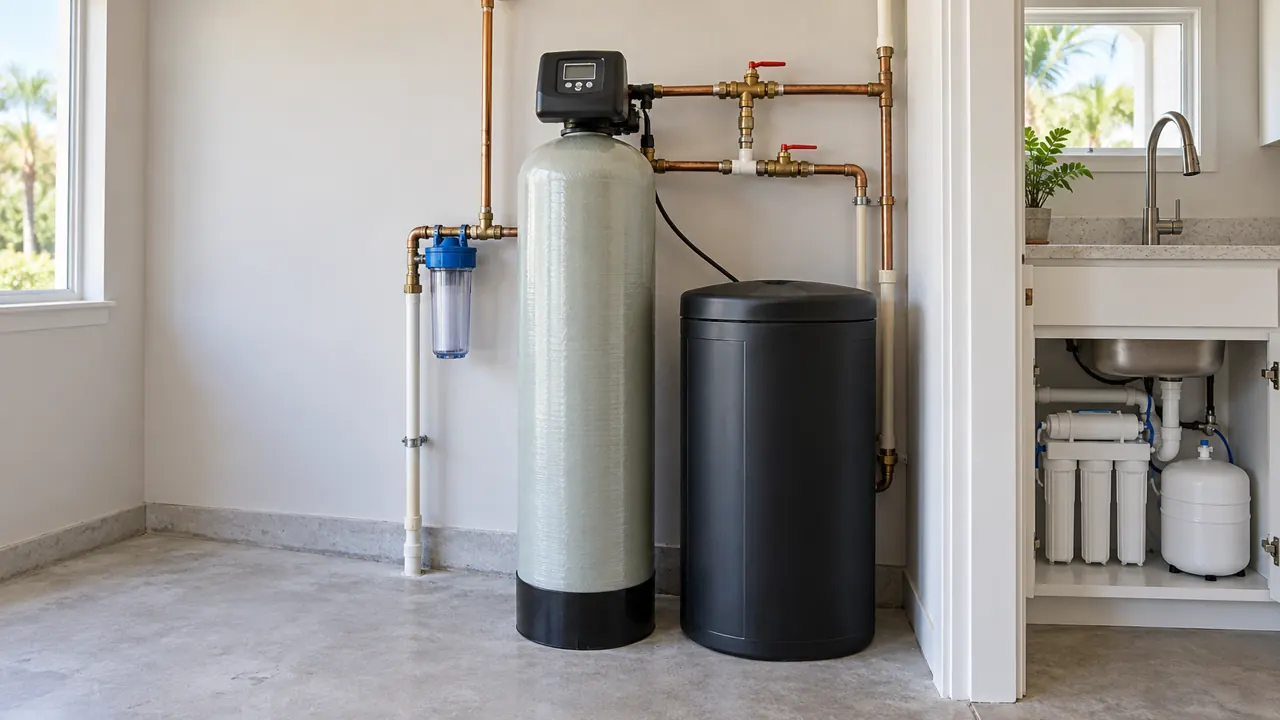
A media vessel near the main line, a separate softener and a compact under-sink drinking-water unit can appear in one property, but a measured objective must justify every stage. Confirm the actual flow path, drain, bypass and service clearance with the installer.
A practical buying process
Check the municipal utility serving your address, or identify a private well. A Palm City mailing address alone is not a water-provider map. Use a Consumer Confidence Report for the correct utility, then consider what it does and does not say about the property.
Write down where and when you notice the issue, what equipment is already installed and whether your concern is aesthetic, operational or tied to a particular lab finding. A TDS reading by itself cannot answer every water-safety question. Ask for the test suited to the decision.
Before sizing, a provider should review service-entry location, pressure, peak demand, drain, electrical access, bypass, weather protection and clearance for future maintenance. Some equipment needs backwash flow; others need a sanitary RO drain or a separate drinking-water faucet.
After these steps, compare written proposals with equipment model, relevant claims, performance rating, installation scope, verification plan, ongoing service and exclusions. A proposal that skips measurement or states every home needs the same package is difficult to evaluate.
Installation and ownership
The lowest equipment price may not be the lowest lifetime cost. Ask how often a carbon medium, sediment cartridge, membrane or softener resin needs attention; whether the home needs salt, regeneration water or electricity; and who will perform the work. Media life depends on the water entering the unit, volume treated and the maker’s instructions. Claims such as “maintenance free forever” need careful written support.
Installation cost changes with the service line, equipment capacity, plumbing access, drain, power and any code or permit requirements. Written quotes should separate hardware, labor, startup, consumables, optional additions and warranty. An operator should explain what was measured at startup and how the homeowner can recognize a service problem later.
Palm City homes may have space near a garage or exterior utility area, but that is not a promise about any specific property. The actual installer should check sun and rain exposure, safe clearances, where a full-flow bypass fits, and whether irrigation or outdoor hose bibs should be separated from treatment. A clean diagram helps you compare layout options before work begins.
Municipal and well water
The supplying utility’s report is a public accountability document for its water system. EPA’s Consumer Confidence Report guide explains what these reports cover. A utility’s compliance information can help a resident understand systemwide monitoring and treatment, while a test at the tap can help determine whether a household system meets an individual goal. A compliant report is not evidence that the water is unsafe; an aesthetic preference is a legitimate but different reason to compare systems.
Private wells are the owner’s responsibility. EPA recommends routine checks for total coliform bacteria, nitrates, total dissolved solids and pH, with other tests based on local conditions. No citywide page can state the condition of a private well. If a lab result indicates a health-related issue, use the laboratory and qualified public-health advice to decide the immediate response. Treatment selection and verification should follow the actual result, not a generic list of “dangerous” substances.
The local water guide explains these boundaries and links directly to the source documents. It intentionally avoids city-name swaps and unverified hazard claims.
Frequently asked questions
No. Confirm the supplier or private well for the address, then measure the condition relevant to the decision. Each utility report describes its own regulated system, not every home on the Palm City.
No. A conventional softener exchanges hardness minerals. A filter may reduce a particular aesthetic or certified contaminant target, depending on the exact model and media. One does not guarantee the other's job.
Not necessarily. A defined drinking-water goal may be served by an under-sink system. A whole-home choice makes sense when the target exists across taps or affects equipment throughout the home, after sizing and cost review.
No. A limited field screen can help choose equipment for a measured condition, but a health-related question may require a certified laboratory and appropriate sampling. Ask exactly what is included.
Simple Water Service receives assessment and installation requests. The provider confirms service coverage, qualifications and scope for the actual property before work is agreed.
The useful next step is to share your water source if known, describe the symptoms, and ask for the measurements and specifications that would change the recommendation. Start with the service comparison or request an assessment.
by Simple Water Service
Share your source, concern and existing equipment. Simple Water Service confirms coverage and the assessment or service scope.
Call (561) 309-6270If the form does not load, open the quote form. Submitting requests contact; it does not confirm an appointment.